Evolution Of Mathematics

Understand the nature of my writing, I am not an expert in this field but I learn as I write. This approach helps me grasp the fundamental uses of mathematics and why they have been employed since ancient times. Without mathematics, the world would likely experience slower progress in technology, science, and everyday life. Given the incredible intellectual capacity humans possess, it is essential to use this ability for good and to protect our planet.
Mathematics is a remarkable human invention that has been instrumental in analysing our world and solving complex problems. Its development has been a cornerstone of technological advancement. Historically, mathematics was employed in diverse areas such as building, astronomy, and understanding natural phenomena through numerical patterns. While I am still learning about the intricacies of mathematics, I recognize that my explanations may contain errors, which I will rectify as my knowledge grows.
Let us divide Mathematics into 2 categories for easy understanding:
Basic Math
- Arithmetic: Addition, subtraction, multiplication, division, fractions, decimals, percentages.
- Geometry: Shapes, angles, measurements, area, volume.
- Algebra: Equations, variables, solving for unknowns.
Higher Math
- Trigonometry: Relationships between side lengths and angles of triangles.
- Calculus: Rates of change, optimization, integration.
- Statistics and Probability: Data analysis, chance, and uncertainty.
Basic Maths
Basic Arithmetic Operations
The four fundamental arithmetic operations are:
- Addition: Combining numbers to find their total.
- Example: 3 + 4 = 7
- Subtraction: Finding the difference between two numbers.
- Example: 8 - 5 = 3
- Multiplication: Repeated addition of the same number.
- Example: 5 × 3 = 15
- Division: Splitting a number into equal parts.
- Example: 12 ÷ 3 = 4
Beyond the Basics
While these are the core operations, arithmetic also encompasses:
- Exponentiation: Repeated multiplication of a number by itself.
- Example: 2^3 = 2 × 2 × 2 = 8
- Root extraction: Finding the base of an exponent.
- Example: √9 = 3
- Logarithms: The inverse of exponentiation.
- Example: log₂8 = 3
Basic Geometric Concepts
- Points: These are the fundamental building blocks of geometry. They represent a location but have no dimension.
- Lines: These are formed by connecting two points and extending infinitely in both directions.
- Planes: A flat, two-dimensional surface extending infinitely in all directions.
- Angles: Formed by the intersection of two lines.
- Shapes: Figures formed by combining points, lines, and curves.
Example
The Pythagorean theorem can be expressed as:
- a² + b² = c²
- Where:
- a and b represent the lengths of the legs of a right triangle
- c represents the length of the hypotenuse
- Where:
Example: Area of a Triangle
The formula for the area of a triangle using symbols:
- A = (bh) / 2
- Where:
- A represents the area
- b represents the base
- h represents the height
- Where:
Symbols
- Pi: π (represents the ratio of a circle's circumference to its diameter)
- Degree: ° (used to measure angles)
- Radians: rad (another unit for measuring angles)
Basic Concepts:
- Variables: These are letters (like x, y, or z) that represent unknown values.
- Expressions: Combinations of numbers, variables, and operations (like addition, subtraction, multiplication, and division).
- Equations: Mathematical statements that show two expressions are equal.
Example:
- Arithmetic: 2 + 3 = 5
- Algebra: x + 3 = 5
In the algebraic equation, we're trying to find the value of x that makes the equation true. In this case, x = 2.
Why is Algebra Important?
- Problem-solving: It provides a systematic approach to solving problems.
- Generalization: It allows us to represent patterns and relationships.
- Modelling real-world situations: It can be used to describe and predict real-world phenomena.
Branches of Algebra:
- Elementary algebra: Deals with basic algebraic operations and solving equations.
- Abstract algebra: Studies algebraic structures like groups, rings, and fields.
- Linear algebra: Focuses on linear equations and vector spaces.
Higher Math
The baton was then passed to the Islamic world during the Middle Ages. Mathematicians like Al-Khwarizmi and Abu al-Wafa built on this foundation, making trigonometry an independent field of study. They even developed all six trigonometric functions we use today.
Thanks to translations of Arabic and Greek texts, trigonometry found its way to Europe during the Renaissance. Regiomontanus played a key role in its adoption in the West.
The final leg of our journey takes us to the 17th-century Age of Enlightenment. Here, mathematicians like Isaac Newton and James Stirling contributed further. Finally, in 1748, Leonhard Euler cemented trigonometry's modern form. Thanks to the earliest Islamic ancient works on trigonometry
- Right-angled triangles: Triangles with one angle equal to 90 degrees.
- Trigonometric ratios: These are ratios of the sides of a right-angled triangle for its angles. The primary ones are sine (sin), cosine (cos), and tangent (tan).
- Trigonometric functions: These are functions that relate angles to ratios of side lengths.
- Pythagorean theorem: A fundamental relationship between the sides of a right-angled triangle: a² + b² = c².
Applications
Trigonometry is used extensively in various fields:
- Physics: To analyze motion, waves, and electricity.
- Engineering: For structural design, surveying, and navigation.
- Astronomy: To calculate distances and positions of celestial bodies.
- Geography: For mapmaking and surveying.
Simple Calculus Example: Finding the Slope of a Curve
Problem:
Let's say we have a curve defined by the equation:y = x^2
We want to find the slope of this curve at the point (2, 4).
Using Calculus: Differentiation
To find the slope of a curve at a specific point, we use a process called differentiation. The derivative of a function gives us the formula for the slope of the curve at any point.
The derivative of y = x^2 is:dy/dx = 2x
Finding the Slope at (2, 4)
Now, we substitute x = 2 into the derivative:dy/dx = 2(2) = 4
Therefore, the slope of the curve y = x^2 at the point (2, 4) is 4.
Visualizing the Result
If you were to graph the function y = x^2, you would see that at the point (2, 4), the tangent line (the line that just touches the curve at that point) would have a slope of 4.
This is a basic example of differentiation. Calculus involves much more complex functions and techniques, but this gives you a foundational idea of how it works.
Higher Maths - Statistics and ProbabilityIn ancient times, governments used numbers to count people and things for taxes and armies. Over time, people realized they could use numbers to understand more than just taxes. They started collecting information and figuring out what it meant.
Today, we use statistics everywhere! Scientists use it to study the world. Businesses use it to make money. Even sports teams use it to win games!
Computers have made it super easy to collect and work with lots of numbers. This helps us find patterns and make smart decisions.
Example of use:
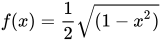
Johann Heinrich Lambert in his 1765 book Anlage zur Architectonic proposed the semicircle as a distribution of errors:
Other Simple Example: Coin Flipping and Statistics
Probability
Let's start with a simple example: flipping a coin.
- Possible outcomes: Heads or tails.
- Probability of heads: 1/2 (or 50%)
- Probability of tails: 1/2 (or 50%)
Statistics
Now, let's say we flip a coin 10 times and get the following results:
Heads: 6 times
Tails: 4 times
Statistics: We can calculate the relative frequency of heads as 6/10 = 0.6 or 60%.
Comparison: This is different from the theoretical probability of 50%. This difference could be due to chance or other factors.
Connecting Probability and Statistics
If we flip the coin a very large number of times (e.g., 1000 times), the relative frequency of heads will likely get closer to the theoretical probability of 50%. This is a fundamental concept in statistics.


Comments
Post a Comment