Evolution Of Airplane
The evolution of the aeroplane is a testament to human ingenuity and perseverance. Inspired by the natural flight of birds, early attempts to achieve controlled flight were often unsuccessful. However, the Wright brothers' groundbreaking work in the early 1900s revolutionized aviation.
Through meticulous research, experimentation, and a relentless pursuit of their dream, the Wright brothers developed the first successful aeroplane. Their innovative approach to aerodynamic control, which allowed for precise manoeuvring, was a key factor in their success.

The Wright brothers' historic flight on December 17, 1903, marked a turning point in human history and paved the way for the development of modern aviation.
Where do the Wright brothers attend college to pursue their aviation dream?
Here is the big question that arises. There was no aviation school which demonstrated a successful flying plane.
The Wright brothers were self-taught in many areas, including mathematics. Yes, that's true you heard it right! While they never attended college, their education included subjects like algebra, geometry, and trigonometry.
These mathematical skills were crucial for their work in aviation. They used them to:
- Calculate the forces of lift and drag: Understanding these forces was essential for designing aircraft that could stay airborne.
- Determine the optimal wing shape: The brothers experimented with different wing shapes and used mathematics to determine which ones would produce the most lift.
- Calculate the power required for flight: They needed to know how much power their engines would need to generate to overcome the forces of gravity and air resistance.
- Design propellers: The Wright brothers experimented with different propeller designs and used mathematics to calculate their efficiency.
Their mathematical knowledge and their ability to apply it to practical problems were key factors in their success in creating the first successful aeroplane.
Their practical ability to solve real-life problems in the technical field made a ground-breaking aviation history. This should be an inspiration to many people out there who never had the chance to attend higher education or able to get educational facilities from colleges or universities. Remember that nature is the great teacher and the universe is the most excellent university.
Humans dreamed of flying science in ancient times as I delved deeper into the history of mathematics and physics ancient civilizations had made a contribution to modern physics as we experience now in this technological world, the ancient people although high-level complex mathematical solutions did not make successfully aviation or near attempt of successfully flying or they had and eventually destroyed over the time laps as for the areological evidence since 1000 years there was no concrete evidence to claim that ancient people has succeeded in flying.

- Greek contributions: Ancient Greeks like Archimedes and Aristotle explored concepts of mechanics, hydrostatics, and aerodynamics, which are fundamental to understanding flight
- Indian contributions: Indian mathematicians like Aryabhatta made significant contributions to trigonometry, which is essential for understanding the relationships between angles, distances, and forces involved in flight.
- Chinese contributions: The ancient Chinese developed advanced engineering techniques and invented devices like kites and hot air balloons, which demonstrated principles of aerodynamics.


While these ancient civilizations didn't achieve sustained, controlled flight, their mathematical and scientific discoveries provided a foundation for later generations to build upon. It's a testament to the enduring human desire to conquer the skies and the ingenuity that has driven technological progress.
The 4 Laws of Aerodynamics
Aerodynamics is the study of the movement of air around objects, and in aviation, it is a crucial field of study that underpins everything from the design of aircraft to the principles of flight. The four laws of aerodynamics are the fundamental principles that govern how air behaves around objects in motion. In aviation, these laws are essential for understanding the principles of flight and how aeroplanes can take off, fly, and land. Let's take a closer look at these four laws.

The first law of aerodynamics is the law of lift. This law states that an object moving through a fluid (in this case, air) will experience a force perpendicular to the direction of motion. In the case of an aeroplane, this force is known as lift and is created by the shape of the wing. The curved shape of the wing, known as the airfoil, creates a difference in air pressure between the top and bottom surfaces of the wing, which results in a net upward force.
The second law of aerodynamics is the law of weight. This law states that all objects have weight and that this weight must be overcome for an object to achieve flight. In the case of an aeroplane, this weight includes the weight of the aircraft itself, as well as the weight of its fuel, passengers, and cargo.
The third law of aerodynamics is the law of thrust. This law states that to achieve and maintain flight, an aeroplane must have a forward force known as thrust. This forward force is typically provided by a jet engine or propeller, which propels the aeroplane forward through the air.
The fourth law of aerodynamics is the law of drag. This law states that all objects moving through a fluid will experience resistance, known as drag. In the case of an aeroplane, this drag is caused by the friction between the aircraft and the air around it. To overcome this drag, an aeroplane must be designed to be as streamlined as possible.
In aviation aerodynamics lift, weight, thrust, and drag - are essential for understanding the principles of flight and how aeroplanes can take off, fly, and land. By understanding these laws, pilots and engineers can design and operate aircraft that are safe, efficient, and effective.
1. Bernoulli's Principle:
- As the speed of a fluid (like air) increases, its pressure decreases.
- This principle explains how an aeroplane's wings generate lift. The air flowing over the top of the wing travels faster than the air flowing beneath it, creating a lower pressure above the wing and higher pressure below. This pressure difference results in an upward force, or lift.
A common form of Bernoulli's equation is:
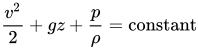
Where:
- is the fluid flow speed at a point,
- is the acceleration due to gravity,
- is the elevation of the point above a reference plane, with the positive -direction pointing upward—so in the direction opposite to the gravitational acceleration,
- is the pressure at the chosen point, and
- is the density of the fluid at all points in the fluid.
 is the fluid flow speed at a point,


Bernoulli's principle is fundamental to aviation because it explains how aeroplanes generate lift.
Here's a breakdown of how it works:
- Airfoil Shape: The wing of an aeroplane has a specific shape known as an airfoil. It's curved on top and flat on the bottom.
- Airflow: When an aeroplane moves through the air, the air flows over both the top and bottom surfaces of the wing.
- Speed Difference: Due to the airfoil's shape, the air flowing over the top surface has to travel a longer distance than the air flowing beneath. To cover this longer distance in the same amount of time, the top airflow must move faster.
- Pressure Difference: According to Bernoulli's principle, as the speed of a fluid (like air) increases, its pressure decreases. So, the air flowing over the top of the wing has a lower pressure than the air flowing beneath.
- Lift: This pressure difference creates an upward force on the wing, known as lift. This lift force is what allows the aeroplane to overcome gravity and stay airborne.
In essence, Bernoulli's principle helps us understand how the shape of an aeroplane wing and the movement of air around it work together to generate the lift necessary for flight.
2. Newton's Third Law of Motion:
- Core concept: For every action, there is an equal and opposite reaction.
- Aviation application: This law explains how an aeroplane's propellers or jet engines generate thrust. The engine expels air backwards with force, causing the aeroplane to move forward in response.
3. Newton's First Law of Motion:
- Core concept: An object at rest will remain at rest, and an object in motion will remain in motion with a constant speed and direction unless acted upon by an
unbalanced force. - Aviation application: This law explains why an aeroplane continues to fly in a straight line and at a constant speed unless it is affected by external forces like wind or changes in engine power.
4. Newton's Second Law of Motion:
- Core concept: The acceleration of an object is directly proportional to the net force acting on it and inversely proportional to its mass.
- Aviation application: This law helps explain how an aeroplane accelerates or decelerates in response to changes in thrust, drag, or lift.


Comments
Post a Comment