Bhāskara II
Bhāskara II, also known as Bhaskaracharya, was a brilliant 12th-century Indian mathematician, astronomer, and engineer who lived from approximately 1114 to 1185, around 874 years ago. His scholarly work in Sanskrit was not limited to spiritual knowledge, as many might assume, but also included practical and applicable scientific knowledge passed down through generations.
Many Indians are often unaware of this dual nature of Sanskrit texts, as everyday rituals and prayer practices sometimes overshadow the rich scientific content these texts contain. Commonly, Indians might overlook the fact that while temples were primarily built for devotional services, they also served as repositories of knowledge and science.
The Tamil-speaking Hindus primarily recognized the science within Hindu texts less frequently, despite Tamil being more ancient than Sanskrit. However, Sanskrit speakers, especially the Brahmin groups, meticulously condensed intellectual works into Sanskrit texts—a practice that dates back to the composition of the earliest Sanskrit texts, such as the Rigveda, around 1500-1000 BCE.
This historical context should not be seen as a division between Tamil and Sanskrit speakers. In ancient times, Tamil and Sanskrit shared words and evolved together without discrimination. In fact, one could argue that Tamil played a significant role in the development of the Sanskrit language.
Understanding this rich, shared heritage is essential. The British formally began ruling India in 1858, and their colonial strategies significantly exacerbated divisions among various Indian groups. Their "divide and rule" strategy, including policies like separate electorates for different religious communities, fostered sectarian divisions that persisted long after independence.
Today, efforts to foster unity between Tamil and Sanskrit-speaking communities through cultural, educational, and social initiatives reflect the recognition of their shared history. This modern understanding celebrates the shared words and knowledge preserved for the welfare of society.
By promoting understanding and cooperation, we pave the way for new discoveries and a more inclusive society. It's not about debating who is greater—Tamil or Sanskrit—but about appreciating the depth of knowledge both bring and the potential they have to unleash more discoveries and foster stronger unity.
In the modern world, unity between Sanskrit and Tamil-speaking communities in India has been fostered through various cultural, educational, and social initiatives. It is no longer as it was in the past; Tamil and Sanskrit now recognize their shared words and knowledge, preserved for the welfare of society.
I touch on this topic to emphasize that the period of discrimination and division has ended. We are now in an era where sharing knowledge and fostering unity among all groups of people is paramount. If anyone spreads false information about differences between Tamil and Sanskrit or attempts to provoke debates over superiority, this information serves to enhance understanding. It is not about who is greater, Tamil or Sanskrit, but about the depth of knowledge each brings and what we can learn from them. This understanding can unleash new potentials and discoveries, fostering stronger unity among all people and groups.
This is a testament to the power of shared knowledge and mutual respect. By promoting understanding and cooperation, we pave the way for new discoveries and a more inclusive society. While British rule in India had many negative impacts, there were also positive contributions that have shaped modern India.
- Siddhanta Shiromani: His magnum opus, this treatise is divided into four parts: Lilavati (arithmetic), Bijaganita (algebra), Grahaganita (mathematics of the planets), and Goladhyaya (spherical astronomy).
- Lilavati: A treatise on arithmetic and algebra, named after his daughter. It includes problems and solutions that demonstrate advanced mathematical concepts.
- Bijaganita: Focuses on algebra, introducing several new concepts and solutions to quadratic equations.
- Grahaganita: Deals with the mathematics of planets, providing detailed astronomical calculations.
- Goladhyaya: Covers spherical astronomy, including methods for calculating celestial phenomena.
- Calculus: Bhāskara II made early contributions to the field of calculus, including concepts of differentiation and infinitesimals.
- Pi Approximation: He provided an accurate approximation of π (pi).
- Astronomy: His work included accurate predictions of planetary positions and eclipses.
- Mathematical Innovation: He developed solutions for quadratic equations and worked on the concept of zero and infinity.
Philosophy and Physics: Concepts like karma and dharma in Hindu philosophy have parallels with principles of cause and effect and natural order, showing a seamless integration of spiritual and physical laws.

Bhāskara the teacher was an Indian polymath, mathematician, astronomer and engineer. From verses in his main work, Siddhāṁta Śiromaṇī, it can be inferred that he was born in 1114 in Vijjadavida and living in the Satpuda mountain ranges of Western Ghats, believed to be the town of Patana in Chalisgaon, located in present-day Khandesh region of Maharashtra by scholars. In a temple in Maharashtra, an inscription supposedly created by his grandson Changadeva, lists Bhaskaracharya's ancestral lineage for several generations before him as well as two generations after him. Henry Colebrooke who was the first European to translate (1817) Bhaskaracharya II's mathematical classics refers to the family as Maharashtrian Brahmins residing on the banks of the Godavari.
Born in a Hindu Deshastha Brahmin family of scholars, mathematicians and astronomers, Bhaskara II was the leader of a cosmic observatory at Ujjain, the main mathematical centre of ancient India. Bhāskara and his works represent a significant contribution to mathematical and astronomical knowledge in the 12th century. He has been called the greatest mathematician of medieval India. His main work Siddhānta-Śiromaṇi, (Sanskrit for "Crown of Treatises") is divided into four parts called Līlāvatī, Bījagaṇita, Grahagaṇita and Golādhyāya, which are also sometimes considered four independent works. These four sections deal with arithmetic, algebra, mathematics of the planets, and spheres respectively. He also wrote another treatise named Karaṇā Kautūhala.
 |
| Cosmic observatory at Ujjain |
In 1719, Maharaja Sawai Raja Jaisingh of Jaipur, a scholar and astronomer, constructed the observatory. He introduced new instruments like the Sun-Dial, Narivalaya, Digansha, and Transit instruments, which facilitated precise astronomical measurements. This observatory played a crucial role in advancing astronomical knowledge during that period.
 |
| Cosmic Observatory of Ujjain |
Modern developments have ensured the observatory's continued relevance. Renovations in 1982 and 2003 have kept the facility up-to-date, and it has been publishing an annual ephemeris (Panchang) since 1942. Today, the observatory continues to provide valuable astronomical data, bridging the gap between ancient knowledge and contemporary science.
The observatory at Ujjain not only showcases India's historical contributions to astronomy but also serves as a reminder of the enduring quest for knowledge and understanding of the cosmos.
 |
| Page from Lilavati, the first volume of Siddhānta Śiromaṇī. Use of the Pythagorean theorem in the corner. 1650 edition |
Bijaganita
The second section Bījagaṇita(Algebra) has 213 verses. It discusses zero, infinity, positive and negative numbers, and indeterminate equations including (the now called) Pell's equation, solving it using a kuṭṭaka method. In particular, he also solved the 61x2+1=y^2 case that was to elude Fermat and his European contemporaries centuries later.
GrahaganitaIn the third section Grahagaṇita, while treating the motion of planets, he considered their instantaneous speeds. He arrived at the approximation: It consists of 451 verses
- for.
- close to , or in modern notation:
- .



bimbārdhasya koṭijyā guṇastrijyāhāraḥ phalaṃ dorjyāyorantaram
This result had also been observed earlier by Muñjalācārya (or Mañjulācārya) mānasam, in the context of a table of sines.
Bhāskara also stated that at its highest point a planet's instantaneous speed is zero.
- A proof of the Pythagorean theorem by calculating the same area in two different ways and then cancelling out terms to get a2 + b2 = c2.
- In Lilavati, solutions of quadratic, cubic and quartic indeterminate equations are explained.
- Solutions of indeterminate quadratic equations (of the type ax2 + b = y2).
- Integer solutions of linear and quadratic indeterminate equations (Kuṭṭaka). The rules he gives are (in effect) the same as those given by the Renaissance European mathematicians of the 17th century.
- A cyclic Chakravala method for solving indeterminate equations of the form ax2 + bx + c = y. The solution to this equation was traditionally attributed to William Brouncker in 1657, though his method was more difficult than the chakravala method.
- The first general method for finding the solutions of the problem x2 − ny2 = 1 (so-called "Pell's equation") was given by Bhaskara II.
- Solutions of Diophantine equations of the second order, such as 61x2 + 1 = y2. This very equation was posed as a problem in 1657 by the French mathematician Pierre de Fermat, but its solution was unknown in Europe until the time of Euler in the 18th century.
- Solved quadratic equations with more than one unknown, and found negative and irrational solutions.
- Preliminary concept of mathematical analysis.
- Preliminary concept of infinitesimal calculus, along with notable contributions towards integral calculus.
- preliminary ideas of differential calculus and differential coefficient.
- Stated Rolle's theorem, a special case of one of the most important theorems in analysis, the mean value theorem. Traces of the general mean value theorem are also found in his works.
- Calculated the derivatives of trigonometric functions and formulae.
- In Siddhanta-Śiromaṇi, Bhaskara developed spherical trigonometry along with a number of other trigonometric results.
Bhaskara's arithmetic text Līlāvatī covers the topics of definitions, arithmetical terms, interest computation, arithmetical and geometrical progressions, plane geometry, solid geometry, the shadow of the gnomon, methods to solve indeterminate equations, and combinations.
Līlāvatī is divided into 13 chapters and covers many branches of mathematics, arithmetic, algebra, geometry, and a little trigonometry and measurement. More specifically the contents include:
- Definitions.
- Properties of zero (including division, and rules of operations with zero).
- Further extensive numerical work, including use of negative numbers and surds.
- Estimation of π.
- Arithmetical terms, methods of multiplication, and squaring.
- Inverse rule of three, and rules of 3, 5, 7, 9, and 11.
- Problems involving interest and interest computation.
- Indeterminate equations (Kuṭṭaka), integer solutions (first and second order). His contributions to this topic are particularly important since the rules he gives are (in effect) the same as those given by the Renaissance European mathematicians of the 17th century, yet his work was of the 12th century. Bhaskara's method of solving was an improvement of the methods found in the work of Aryabhata and subsequent mathematicians.
His work is outstanding for its systematisation, improved methods and the new topics that he introduced. Furthermore, the Lilavati contained excellent problems and it is thought that Bhaskara's intention may have been that a student of 'Lilavati' should concern himself with the mechanical application of the method.
AlgebraHis Bījaganita ("Algebra") was a work in twelve chapters. It was the first text to recognize that a positive number has two square roots (a positive and negative square root). His work Bījaganita is effectively a treatise on algebra and contains the following topics:
- Positive and negative numbers.
- The 'unknown' (includes determining unknown quantities).
- Determining unknown quantities.
- Surds (includes evaluating surds and their square roots).
- Kuṭṭaka (for solving indeterminate equations and Diophantine equations).
- Simple equations (indeterminate of second, third and fourth degree).
- Simple equations with more than one unknown.
- Indeterminate quadratic equations (of the type ax2 + b = y2).
- Solutions of indeterminate equations of the second, third and fourth degree.
- Quadratic equations.
- Quadratic equations with more than one unknown.
- Operations with products of several unknowns.
Bhaskara derived a cyclic, chakravala method for solving indeterminate quadratic equations of the form ax2 + bx + c = y. Bhaskara's method for finding the solutions of the problem Nx2 + 1 = y2 (the so-called "Pell's equation") is of considerable importance.
TrigonometryThe Siddhānta Shiromani (written in 1150) demonstrates Bhaskara's knowledge of trigonometry, including the sine table and relationships between different trigonometric functions. He also developed spherical trigonometry, along with other interesting trigonometrical results. In particular Bhaskara seemed more interested in trigonometry for its own sake than his predecessors who saw it only as a tool for calculation. Among the many interesting results given by Bhaskara, results found in his works include computation of sines of angles of 18 and 36 degrees, and the now well-known formulae for and .


His work, the Siddhānta Shiromani, is an astronomical treatise and contains many theories not found in earlier works. Preliminary concepts of infinitesimal calculus and mathematical analysis, along with a number of results in trigonometry, differential calculus and integral calculus that are found in the work are of particular interest.
Evidence suggests Bhaskara was acquainted with some ideas of differential calculus. Bhaskara also goes deeper into the 'differential calculus' and suggests the differential coefficient vanishes at an extremum value of the function, indicating knowledge of the concept of 'infinitesimals'.
- There is evidence of an early form of Rolle's theorem in his work. The modern formulation of Rolle's theorem states that if , then for some with .
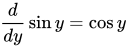
- In this astronomical work he gave one procedure that looks like a precursor to infinitesimal methods. In terms that is if then that is a derivative of sine although he did not develop the notion on derivative.
- Bhaskara uses this result to work out the position angle of the ecliptic, a quantity required for accurately predicting the time of an eclipse.
- In computing the instantaneous motion of a planet, the time interval between successive positions of the planets was no greater than a truti, or a 1⁄33750 of a second, and his measure of velocity was expressed in this infinitesimal unit of time.
- He was aware that when a variable attains the maximum value, its differential vanishes.
- He also showed that when a planet is at its farthest from the earth, or at its closest, the equation of the centre (measure of how far a planet is from the position in which it is predicted to be, by assuming it is to move uniformly) vanishes. He therefore concluded that for some intermediate position the differential of the equation of the centre is equal to zero. In this result, there are traces of the general mean value theorem, one of the most important theorems in analysis, which today is usually derived from Rolle's theorem. The mean value formula for inverse interpolation of the sine was later founded by Parameshvara in the 15th century in the Lilavati Bhasya, a commentary on Bhaskara's Lilavati.




Madhava (1340–1425) and the Kerala School mathematicians (including Parameshvara) from the 14th century to the 16th century expanded on Bhaskara's work and further advanced the development of calculus in India.
Astronomy
Using an astronomical model developed by Brahmagupta in the 7th century, Bhāskara accurately defined many astronomical quantities, including, for example, the length of the sidereal year, the time that is required for the Earth to orbit the Sun, as approximately 365.2588 days which is the same as in Suryasiddhanta. The modern accepted measurement is 365.25636 days, a difference of 3.5 minutes.
His mathematical astronomy text Siddhanta Shiromani is written in two parts: the first part on mathematical astronomy and the second part on the sphere.
The twelve chapters of the first part cover topics such as:
- Mean longitudes of the planets.
- True longitudes of the planets.
- The three problems of diurnal rotation. Diurnal motion refers to the apparent daily motion of stars around the Earth, or more precisely around the two celestial poles. It is caused by the Earth's rotation on its axis, so every star apparently moves on a circle that is called the diurnal circle.
- Syzygies.
- Lunar eclipses.
- Solar eclipses.
- Latitudes of the planets.
- Sunrise equation.
- The Moon's crescent.
- Conjunctions of the planets with each other.
- Conjunctions of the planets with the fixed stars.
- The paths of the Sun and Moon.
The second part contains thirteen chapters on the sphere. It covers topics such as:
- Praise of study of the sphere.
- Nature of the sphere.
- Cosmography and geography.
- Planetary mean motion.
- Eccentric epicyclic model of the planets.
- The armillary sphere.
- Spherical trigonometry.
- Ellipse calculations.
- First visibilities of the planets.
- Calculating the lunar crescent.
- Astronomical instruments.
- The seasons.
- Problems of astronomical calculations.
The earliest reference to a perpetual motion machine date back to 1150, when Bhāskara II described a wheel that he claimed would run forever.
Bhāskara II invented a variety of instruments one of which is Yaṣṭi-yantra. This device could vary from a simple stick to V-shaped staffs designed specifically for determining angles with the help of a calibrated scale.
Legacy
A number of institutes and colleges in India are named after him, including Bhaskaracharya Pratishthana in Pune, Bhaskaracharya College of Applied Sciences in Delhi, Bhaskaracharya Institute For Space Applications and Geo-Informatics in Gandhinagar.
On 20 November 1981 the Indian Space Research Organisation (ISRO) launched the Bhaskara II satellite honouring the mathematician and astronomer.
Invis Multimedia released Bhaskaracharya, an Indian documentary short on the mathematician in 2015.
Bhāskara II used several innovative astronomical tools and instruments for his observations and calculations:
 |
| Chakra Yantra (Disk Instrument): This was a type of protractor used for angular marking of land and positioning of cities1. It was also used to measure time and astrological parameters like 'natta' and 'unnatta'. |
 |
| Goladhyaya (Spherical Instruments): These instruments were used for spherical astronomy, including calculations related to celestial bodies. |

Grahaganita (Mathematics of the Planets): This involved detailed astronomical calculations and predictions of planetary positions and eclipses.
 |
| Sun-Dial: Used for measuring time based on the sun's position. |
How did they discover without knowing the speed of light?
Bhāskara II and other ancient astronomers could make remarkable astronomical calculations without the concept of the speed of light. They relied on observable phenomena, meticulous recording, and mathematical principles. Here’s how they did it:
Planetary Positions: Using detailed observations and recording planetary motions over long periods, they developed predictive models. Bhāskara II, for example, used trigonometry to calculate the positions of planets.
Eclipses: By understanding the geometry of the Earth, Moon, and Sun, ancient astronomers could predict eclipses with great accuracy.
Sidereal and Synodic Periods: They used the regular cycles of celestial objects, like the synodic period of the Moon and the sidereal period of planets, to make calculations. These periods are based on observable motion relative to the stars.
Angular Measurements: Instruments like the Chakra Yantra and Sun-Dials helped measure the angles between celestial bodies, aiding in their calculations.
Mathematical Models: They developed advanced mathematical models that didn’t require the speed of light. Bhāskara II’s use of algebra, trigonometry, and spherical astronomy were key.
Cultures around the world, including the Egyptians, Greeks, Chinese, and Maya, made observations of Mars and noted its unique colour and movement against the backdrop of stars. These early observations were primarily qualitative, focusing on the planet's brightness, colour, and apparent motion.
Bhāskara II, a brilliant 12th-century mathematician and astronomer, exemplifies this meticulous approach. His contributions to mathematics and astronomy, particularly through works like the Siddhanta Shiromani, highlight the blend of scientific knowledge preserved in Sanskrit texts. These texts, far from being merely spiritual, encompass a vast repository of practical and theoretical knowledge.
Understanding the historical context of British rule in India, which exacerbated divisions among various groups, also sheds light on the importance of unity and shared knowledge in today's world. Modern efforts to foster unity between Tamil and Sanskrit-speaking communities through cultural, educational, and social initiatives demonstrate the power of mutual respect and understanding.
By appreciating the intricate web of history, culture, and knowledge, we can unlock new potentials and discoveries, fostering a more inclusive and enlightened society.


Comments
Post a Comment